

 Ruminants
  Poultry
  Swine
Swine  Fishes / aquaculture
 Pet
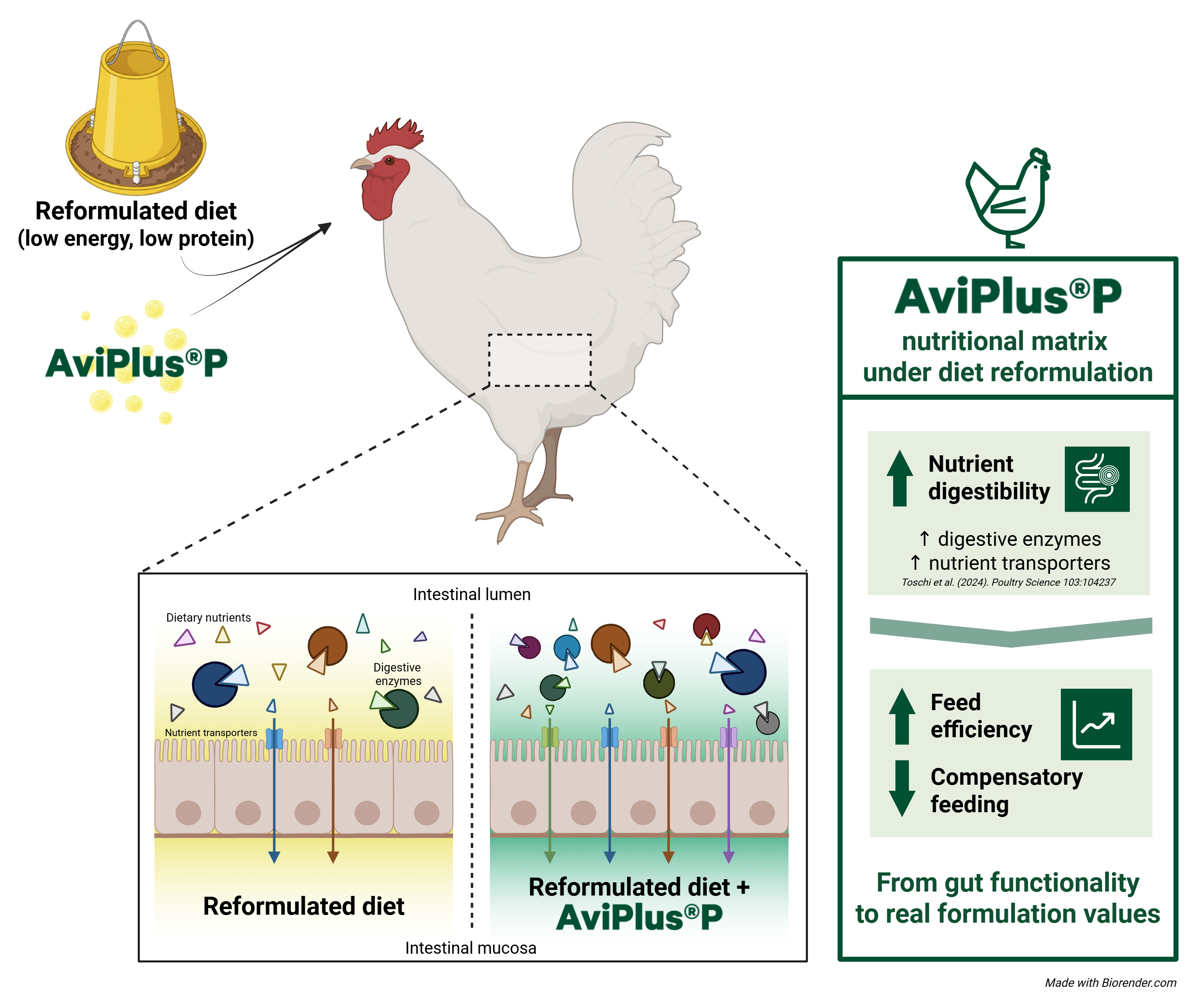
PetThe poultry industry relies on gut health additives to increase productivity, while sustainability demands control on cost and resource efficiency, encouraging reformulation. Although studies investigate the nutritional effects of such additives in poultry, these have rarely been translated into practical nutritional matrix for broiler diets. From a large database of 35 in vivo trials, we developed a nutritional matrix for a gut health feed additive (a microencapsulated blend of organic acids and botanicals, mOAB). This study evaluated whether mOAB nutritional matrix could improve digestibility and prevent performance loss in broilers fed a low-energy, low-protein (reformulated) diet.
A total of 810 Ross 308 day-old male chicks (18 birds/pen) were assigned to 3 groups (n=15): STD, standard diet; REF, reformulated diet (-80 kcal ME; -2% CP and digestible AA vs STD); APP, REF diet + 300g/MT mOAB (AviPlus®P, Vetagro S.p.A., Italy). Growth performance parameters were measured on d14, d28, d41. A TiO2 tracer was added (0.3%) in the diets on d31-32 to assess fecal digestibility of dry matter (DM), crude protein (CP), crude fat (CF), and AMEn. Data were analyzed with One-Way ANOVA and Tukey post-hoc test. Differences were significant with P≤0.05, tendencies with P≤0.1.
In the starter (d0-14), BW was similar across treatments, but REF showed a loss in feed efficiency (P=0.006), while APP restored FCR. During the grower (d14-28), BW was similar among groups, with a trend in favor of STD compared to REF and APP for FCR. During finisher (d28-41), no differences were observed for BW, while REF FCR was numerically higher (1.75) compared to STD (1.72) and APP (1.73). In the overall period (d0-41), REF had a numerically higher ADFI (121.8g) than STD (119.6g) and APP (120.7g) (P=0.174), leading to a higher FCR in REF compared to STD (1.56 vs 1.53; P=0.003), with APP achieving a value (1.54) numerically closer to STD. About digestibility, APP showed higher CP digestibility compared to STD (P=0.038). Moreover, CF digestibility was improved in APP compared to REF (P<0.001), bringing it to STD levels. A significant drop in AMEn digestibility (P=0.003) was measured for REF (2827 kcal/kg DM) compared to STD (2873 kcal/kg DM), whereas APP had an intermediate response (2852 kcal/kg DM).
Diet reformulation negatively affected broilers’ performance, confirming that low-density diets compromise performance. However, mOAB, used with a nutritional matrix, improved FCR, indicating an enhanced nutrient utilization. This is supported by digestibility, that showed higher CP, CF, and AMEn digestibility of the reformulated diet with mOAB, restoring the protein gap and the metabolizable energy gap introduced by reformulation, consistently with a better nutrient use. In conclusion, mOAB proved effective as a gut health additive with a specific nutritional matrix to support the reformulation process of broiler feeds. This application can allow greater formulation flexibility without compromising broilers’ growth performance, supporting poultry diet management in terms of costs and sustainability.
Enhancing nutrients use under diet reformulation: linking gut health and performance through a functional feed additive in broilers