
 Ruminants
  Poultry
  Swine
Swine  Fishes / aquaculture
 Pet
Pet
When yield falls during a heat wave, are we sure we’re looking in the right place?
The first signal, when the heat sets in, comes from the milk tank. But the problem doesn’t start there. In a heat-stressed cow, everything begins somewhere else, in a much less visible spot: the intestinal barrier.
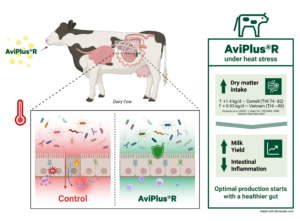
To dissipate heat, the body diverts blood flow away from the visceral organs toward the periphery. The gut is left short of oxygen and energy, and the proteins (tight junctions) holding the epithelial cells together start to give way. The barrier that should keep gut contents separate from the bloodstream becomes permeable. This isn’t just a “leaky gut”: it’s an open door for toxins and bacteria, which reach systemic circulation and trigger a widespread inflammatory response.
And that response comes at a cost. Mounting an immune response can pull up to 2 kg of glucose per cow per day away from milk synthesis, a cost the cow pays well before a single clinical sign shows up in the barn. Protecting intestinal integrity in summer isn’t a detail: it’s what decides how much milk actually gets produced.
This is where AviPlus®R comes in, Vetagro’s microencapsulated blend of organic acids and botanical compounds. Microencapsulation protects the active ingredients through the upper digestive tract and allows for their gradual release at the intestinal level. There, the organic acids work in synergy with the botanicals to contain the proliferation of unwanted bacteria and reinforce mucosal integrity. The result is a stronger, less permeable barrier, with less energy diverted away from milk production.
To test this hypothesis in the field, we compared two very different heat-stress scenarios: a controlled university study and a commercial farm in full operation.
At Cornell University, Fontoura and colleagues (2022, J. Dairy Sci.) worked with Holstein cows exposed to a THI of 74–82. Compared to controls, the group fed AviPlus®R ate 1.4 kg/day more dry matter and produced 2.7 kg/day more milk.
In Vietnam, in 2025, the scenario was different: chronic heat stress, with a mean THI of 79.7 (range 75–84) across the entire trial. Here AviPlus®R increased dry matter intake by 0.93 kg/day and milk yield by 0.65 kg/day, with a measurable drop in the cost of production per liter.
An academic study and a commercial farm point to the same conclusion. Heat stress starts in the gut, and the data suggest recovery can start there too. Supporting the intestinal barrier is one of the most concrete ways to protect performance through the hottest months.
Discover how AviPlus®R helps preserve gut integrity as temperatures rise.