
 Ruminants
 Poultry
 Swine
 Fishes / aquaculture
 Pet
Boarding for the Future
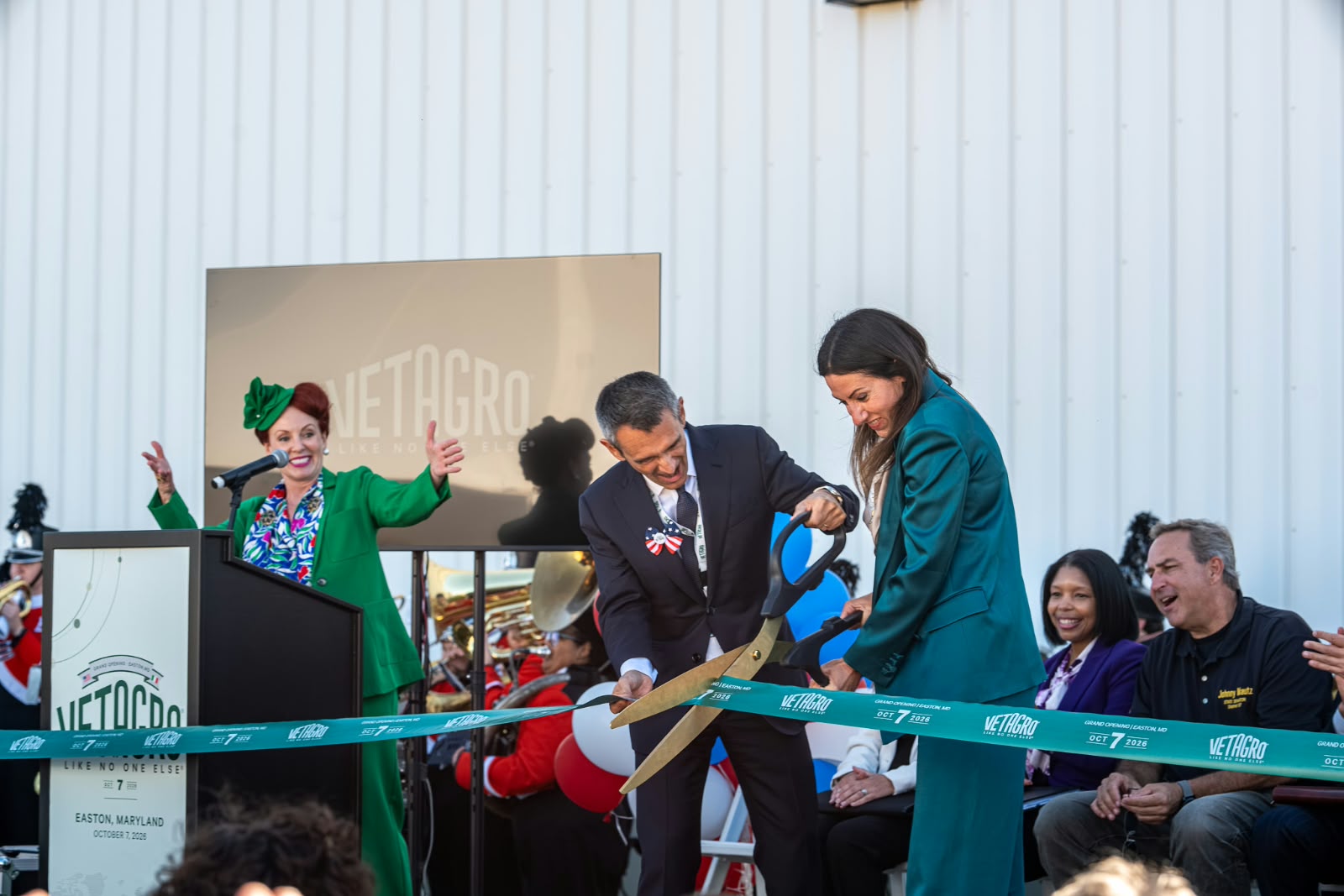
On October 7th, 2026, Vetagro officially opened its new production facility in Easton, Maryland. Before the ribbon cutting, we chose to start where we always start: with science.
The morning seminar, “Boarding for the Future: Vetagro’s Route toward Global Innovation”, brought five international experts together at the Chesapeake Bay Beach Club. Their task was to look at the past, present and future of animal production. Sessions were chaired by Prof. Lance Baumgard, with Vetagro’s Dr. Richard Paratte and Dr. Benedetta Tugnoli.
Here are the key messages of each talk. #FromRootsToFuture
What we got wrong
Dr. Andrea Rosati · Secretary General, EAAP – European Federation of Animal Science
Nobody knows what livestock farming will look like in 2050. What we do know is how our forecasts have failed so far, and that is a valuable guide.
In 1968, The Population Bomb predicted mass famine. Instead, agricultural science multiplied yields. In 2013, cultivated meat was presented as the future; today its market share is still negligible. In 2019, plant-based proteins were expected to bring “the end of meat”, while global meat consumption kept growing.
Meanwhile, the silent revolutions were underestimated. Genomic selection went from a theoretical paper in 2001 to routine practice in dairy cattle in less than ten years. And to produce the same amount of milk as in 1944, the U.S. dairy system of 2007 needed only 21% of the cows, 23% of the feed, 35% of the water and 10% of the land, with a 63% lower carbon footprint per kg of milk. Shocks were missing from the forecasts too: BSE, avian influenza, COVID-19 and African swine fever all rewrote the rules.
The lesson is what futurist Roy Amara observed: we overestimate the short-term effect of a technology and underestimate its long-term effect. The answer is to invest in “no-regret” choices that make sense in any future: genetics, biosecurity, reliable measurement, data that serve the farmer, young people and independent research.
His message was clear: distrust announced revolutions, watch the silent ones, and prepare for shocks, not just trends.
Feeding the future dairy cow
Prof. Mike Van Amburgh · Professor of Animal Science, Cornell University
Today’s dairy cow is, in fact, a new animal. Milk and component yields are rising faster than ever before in commercial herds. In high-performing New York herds, cows are peaking at around 90–97 kg of milk per day, and the genetic capacity of Holsteins is estimated at about 34,000 kg per lactation.
As geneticist Curt Van Tassell put it, “every calf born today is a new genotype”. This means nutrient requirements, especially for essential amino acids, are changing faster than research can measure them. The cows that matter most are not on university farms or in the literature: they are on commercial farms, and they need to be studied there.
When amino acid requirements are met, energy and nitrogen efficiency improve together and milk components respond. Holsteins can produce milk as rich in fat as Jerseys. Methionine, lysine and histidine are the top limiting amino acids, with lysine the key for milk fat and protein. To make more casein, other amino acids such as isoleucine, leucine, valine and arginine also come into play.
Our cows are moving faster than our models, and as Van Amburgh concluded: “Don’t get comfortable; we have a lot to learn.”
Promoting health by managing the four “M’s” of homeostasis
Prof. Brian Aldridge · Carle Illinois College of Medicine, University of Illinois Urbana-Champaign
Health is not an on/off switch between healthy and sick. Animals move through three states: healthy, pre-disease and disease. Rarely do they jump straight from the first to the last.
The pre-disease state is unstable, but still reversible. That makes it the best window to intervene. Once an animal reaches the disease state, it becomes stable in its own way, and much harder to bring back.
What pushes animals out of balance is stress, or as Aldridge tells his students, “stress is spelled C-H-A-N-G-E”. It reaches the animal through four channels, the four “M’s”: mucosal, mental (neuroendocrine), microbial and metabolic. They are distinct but connected: heat stress, for example, hits all of them at once. Repeated, low-grade stressors can be as harmful as a single severe one, and early-life adversity can shape immune development for life.
Resilience can be supported and measured, and the time to act is before disease becomes visible.
Addressing critical global challenges: the “One Health” approach
Dr. Francesc Molist · R&D Director, Schothorst Feed Research, The Netherlands
The global context is getting tougher. Animal protein consumption in South-East Asia and India is expected to grow by 80% in the next 15 years. At the same time, feed prices are more volatile, food, feed and fuel compete for the same cereals, and African swine fever keeps putting pressure on European pig production.
In a One Health perspective, human, animal and environmental health are one system, with antimicrobial resistance at its core. Antibiotic use in livestock has already dropped sharply, and further reductions will not be easy. Prevention becomes the new frontier, and it starts in the gut, the gatekeeper of health.
The first days of life are decisive. Gut, microbiota and immunity take shape early: in chicks, quick access to feed after hatching supports intestinal development, while in piglets quality is built before weaning, from the sow’s diet to colostrum and creep feed. After weaning, without pharmacological zinc oxide, managing the diet and supporting stomach acidity help protect gut health and growth. Feed safety also matters: even mycotoxin levels below guidance values can damage the intestine.
With fewer antibiotics, prevention starts from the gut and from the very first days of life: a good start is half the work.
Is demographics destiny? The future of agriculture
Todd Thurman · International Swine Management Consultant, owner of Swine Insights International
For decades, agriculture has lived through an extraordinary growth era: more people, more income, more global trade. The sector answered by becoming exceptionally good at producing more. Since 1950, U.S. milk output per cow has grown almost fivefold.
That model worked because it matched its time. Population growth explained about two thirds of the increase in global food demand between 1973 and 2023. Today, world population growth has slowed to 0.87% a year, less than half the rate of the 1960s, and populations are ageing fast. By 2050, one in three Europeans will be over 65.
When productivity keeps rising but demand growth slows, “more” is no longer enough. The narrative shifts from more food for a fast-growing population to better food for a changing population. Quality means taste, freshness, safety, nutrition and price. But it pays only when customers reward it more than it costs to deliver.
What got us here will not get us there: the future of agriculture is less about feeding more people, and more about creating more value for each person we feed.
From roots to future
Taken together, the five talks drew a coherent picture. The past teaches us how to navigate and face the complexity of the present. The animal is changing faster than our knowledge of it. Health is decided before disease appears, starting from the gut and the first days of life. And value, not volume, will define success in the future.
These are the same questions that drive our research every day. At Vetagro, we have always started from the animal’s physiology: microencapsulating active compounds so they delivered exactly where needed, supporting the intestine when it is most vulnerable, and proving results in the field, species by species. Our new facility in Maryland is more than a production site. It is a commitment to keep working on these questions alongside producers, nutritionists, veterinarians and partners worldwide.
The future of animal production cannot be predicted, but it can be built, one well-founded choice at a time. With our new home in the United States, Vetagro is ready to board for that future… like no one else.