
 Ruminants
  Poultry
  Swine
Swine  Fishes / aquaculture
 Pet
Pet
Background & Objectives
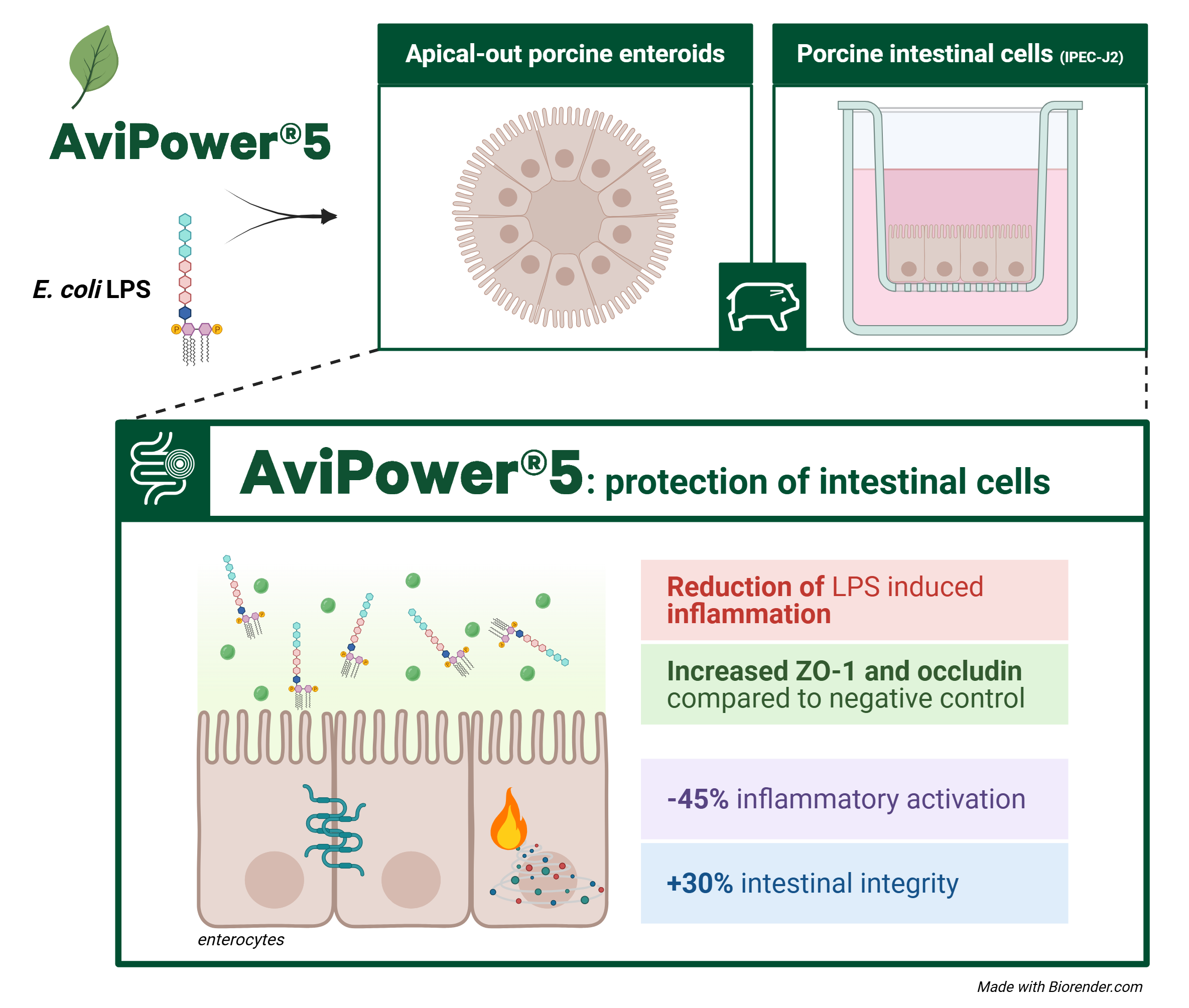
Intestinal inflammation can disrupt intestinal barrier in pigs, leading to reduced performance and increased disease susceptibility. Evaluating botanical interventions requires both screening efficiency and an in-depth understanding of their modes of action. This study investigated whether AviPower®5, a thymol-based botanical blend (BOT), could mitigate inflammatory-induced barrier dysfunction using IPEC-J2 cells as a screening model, with subsequent validation and characterization in apical-out porcine enteroids.
Material & Methods
IPEC-J2 cells were challenged for 24 hours with lipopolysaccharide from E. coli O55:B5 (LPS) and porcine pro-inflammatory cytokines in the presence or absence of BOT supplementation, and transepithelial electrical resistance (TEER) was monitored over eight days to assess barrier function. Following that, apical-out porcine enteroids were generated from jejunal crypts of 35-day-old pigs using EDTA isolation and suspension culture. Enteroids were challenged with LPS for six hours with or without BOT, and paracellular permeability (FD4 assay), inflammatory marker, and tight junction protein mRNA levels were quantified to elucidate underlying mechanisms.
Results
In IPEC-J2 cells, BOT treatment maintained significantly higher TEER values throughout the post-challenge period, achieving complete recovery by day eight, when control was still at 84% of initial value, indicating sustained barrier protection with BOT (p<0.05). When performed on enteroids, LPS challenge increased FD4 permeability by 70% and upregulated IL1β, IL6, IL8, and MUC4 two-fold (p<0.01). In tight junction proteins occludin decreased significantly (p<0.05). Botanical supplementation reduced permeability by 35% (p<0.05), significantly decreased all inflammatory markers, and increased ZO1 and occludin expression by 50% (p<0.05).
Discussion & Conclusion
AviPower®5 demonstrated consistent barrier-protective effects across different porcine intestinal models. Analysis in enteroids revealed preservation of tight junction integrity and attenuation of inflammatory cytokine responses as key protective mechanisms. This botanical blend shows strong potential as a nutritional strategy to enhance intestinal resilience during stressful production phases, offering a promising solution for commercial pig farming.